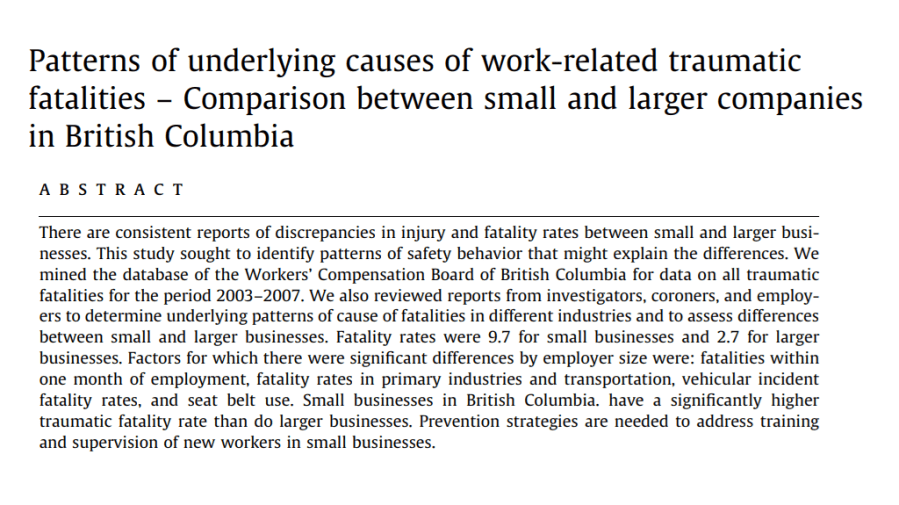
This study mined the Workers’ Compensation Board of British Columbia (WCB) to compare discrepancies in injury and fatalities between small and large businesses. I’ve skipped a lot. For background: · Data from 2003-07 found the traumatic fatality rate among workers in small businesses (<20 person-years) was 9.7 per 100k person-years vs 2.7 per 100k in… Continue reading Patterns of underlying causes of work-related traumatic fatalities – Comparison between small and larger companies in British Columbia
Tag: workplace-safety

Building Resilience into Safety Management Systems: Precursors and Controls to Reduce Serious Injuries and Fatalities (SIFs)
Another on SIF prevention. This (interim) report (another from the recent compendium – see comments for link) covers the findings from a few activities, including two SIF workshops about ID, implementing and monitoring critical controls for SIF hazards, and the role of human and org factors. Too much to cover, so a few extracts: · “the… Continue reading Building Resilience into Safety Management Systems: Precursors and Controls to Reduce Serious Injuries and Fatalities (SIFs)

Automation’s lacklustre effects on fatal accidents & cheap migrant labour hampering adoption of engineering controls
REALLY interesting findings from Associate Professor Masahiro Yoshida. It suggests that automation over a historical context didn’t really drive down workplace injuries since it tended to be employed in already mature industries. And, ready access to cheap migrant workforces may hinder broader industrial risk reduction due to a negative correlation with automation investment. And the… Continue reading Automation’s lacklustre effects on fatal accidents & cheap migrant labour hampering adoption of engineering controls

Compendium: Blame, Just Culture & language
Here’s another compendium of articles exploring blame and language in the construction of post-hoc causality explanations, or how blame effects learning and investigations. The other part covers some articles around Just Culture and restorative culture. Note: I’ve mostly focused on articles that I’ve either already summarised or that I could find a full text link… Continue reading Compendium: Blame, Just Culture & language

The Impact of Physical Hazards on Workers’ Job Satisfaction in the Construction Industry: A Case Study of Korea
This explored the effects of physical hazard exposures on worker job satisfaction. Survey from >2k Korean construction workers. Background: · “physical hazards such as noise, vibration, and exposure to hazardous substances also contribute to job stress” and behavioural changes · “Continuous exposure to such risks can result in cumulative mental and physical strain, increasing job-related stress, and… Continue reading The Impact of Physical Hazards on Workers’ Job Satisfaction in the Construction Industry: A Case Study of Korea
Learning from normal work: How to Proactively Reduce Risk When Nothing Goes Wrong
An interesting article from Marcin Nazaruk, exploring learning from everyday work. Skipping a bit, so check out the full article. First he says that while it’s important to learn from failure “it is too late”. For one, diminishing incident rates “can no longer accurately reflect safety performance … and simply focusing on behaviours and unsafe… Continue reading Learning from normal work: How to Proactively Reduce Risk When Nothing Goes Wrong
Trust, uncertainty and the reporting of workplace hazards and injuries
This study interviewed 121 workers across several Canadian sectors in temporary and permanent employment, exploring ways workers managed workplace hazards given employment insecurity. Not a summary – way too much to cover. Extracts: Ref: Hall, A. (2016). Trust, uncertainty and the reporting of workplaces hazards and injuries. Health, Risk & Society, 18(7-8), 427-448. Study link: https://doi.org/10.1080/13698575.2016.1264576 My… Continue reading Trust, uncertainty and the reporting of workplace hazards and injuries
The limits and of lost time injury and other injury measures: ‘risk blindness’
This Safe Work Australia report mentioned yesterday, authored by O’Neill & Wolfe, discussed measuring & reporting on WHS. One section dived into the limits of injury measures. Some highlights: · “a single injury number or frequency rate is too aggregated to provide meaningful information to guide business decisions” · “the majority of LTIs have relatively short-term consequences… Continue reading The limits and of lost time injury and other injury measures: ‘risk blindness’
The Illusive Pipedream of Zero Harm: A South African Mining Industry Perspective
Not much to say here – nor anything particularly new to practitioners – just thought this was an interesting extract from a study that unpacked South African mining company OHS annual reports. They highlight: · “where the injury rates and OD rates show a decreasing trend over time, this should not be construed to mean that health… Continue reading The Illusive Pipedream of Zero Harm: A South African Mining Industry Perspective
Effectiveness of training in reducing accidents in construction companies
This study evaluated the impact of construction safety training on accident rates in Spanish industry. Data from 1,283 Spanish construction companies over 11 years were analysed. They studied the effects of training in the same year of the accident, and the prior three years. I’m not really sure what to make of these findings –… Continue reading Effectiveness of training in reducing accidents in construction companies
 SafetyInsights.org