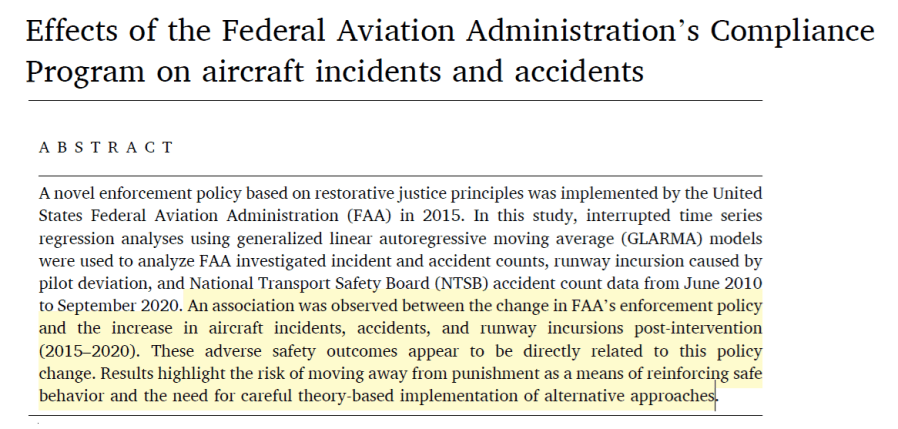
Can a shift from punitive retributive justice towards restorative justice lead to **worsening** incident performance? This paper may interest my Aviation friends: it explores various indices of incident performance pre and post policy FAA policy changes. Prior to the change, the FAA system relied on retributive justice, relying more on sanctions and punishment. Post change,… Continue reading Can a restorative justice approach **worsen** incident performance?
Safe As week in review – 22, 23, 24: Zombie leaders, Safety-II debriefs, and causal illusions of leadership styles
Safe As week in review: E22: Zombie leadership … being “dead ideas [about leadership] that still walk amongst us”. Zombie leadership is covered by several axioms: images 1 and 2. These dead ideas, being already dead can “absorb all kinds of damage and keep lumbering on towards their targets”; that is, difficult to slay. Zombie… Continue reading Safe As week in review – 22, 23, 24: Zombie leaders, Safety-II debriefs, and causal illusions of leadership styles

So you want to be a systems leader?
This article discusses systems leaders (SL). · Systems leaders are “trusted actors who help many people to collaborate to address wicked policy problems” · They’re people “who catalyzes collective leadership” for “deep changes necessary to accelerate progress against society’s most intractable problems” · This is “necessary, to address wicked problems that transcend traditional boundaries” where “no one person… Continue reading So you want to be a systems leader?
NASA and the blinding language of catastrophic risk
NASA’s language of risk was “technical, impersonal, and bureaucratic”. Some extracts from both the Columbia accident report (CAIB 2003 image 1) and Ocasio’s chapter ‘The Opacity of Risk’, in Organization at the Limit (images 2 & 3; awesome book – I think essential reading). I’m writing up both for upcoming summaries, but for now just… Continue reading NASA and the blinding language of catastrophic risk

Sleep Problems and Workplace Violence: A Systematic Review and Meta-Analysis
Are sleep problems (SP) and workplace violence (WV) related? Quite possibly. This meta-analysis and systematic review unpacked 34 studies exploring the links. Extracts: VW can be classified into four types: · “Type 1, Criminal Intent, when no legitimate relationship exists between the perpetrator and the business or its employees and the perpetrator commits a crime (robbery,… Continue reading Sleep Problems and Workplace Violence: A Systematic Review and Meta-Analysis
The three sides of organisations to understand culture: formal, informal, display
A few extracts from Kühl’s interesting book called ‘Influencing Organizational Culture’. It takes more of a deep, analytical and critical lens to ‘conventional’ cultural approaches. Extracts: · Kühl proposes that “to better understand the culture of an organization, we have to systematically distinguish between the three sides of an organization” · The formal side covers the “official… Continue reading The three sides of organisations to understand culture: formal, informal, display

Safe As ep 24: Are leadership styles scientifically valid?
We’ve all been told about the power of positive leadership, servant leadership etc. But what if much of what we believe about these styles is more of an illusion? Today, we’re diving into research that suggests the evidence for positive leadership styles might be more steeped in how leaders are judged, not just what they… Continue reading Safe As ep 24: Are leadership styles scientifically valid?
Safe As pod growth: your help needed
Woot – just hit ~260 members on my LinkedIn Safe As group. This combines with ~400** unique listeners per episode on my pod. Still very small (but growing) numbers – so I think I need to double the listener count by year’s end to make podding worthwhile. Can you help by sharing the pod? Appreciated,… Continue reading Safe As pod growth: your help needed

Disinheriting Fitts and Jones `47 (2001 Sid Dekker article)
A 2001 article from Sid Dekker discussing a contemporary view of human performance and organisational failure. You may recognise parts of this from Dekker’s later article ‘Is it 1947 yet?’. Too much to cover. And I’m relying heavily on quotes. Dekker reverts back to Fitts and Jones’ 1947 article which “laid the foundation for aviation… Continue reading Disinheriting Fitts and Jones `47 (2001 Sid Dekker article)

The day-to-day stability of safety climate in the offshore oil and gas industry
Is safety climate stable day-to-day or more dynamic and variable? A really interesting study which explored the stability of safety climate over a 28 day offshore work period (hitch). Background: · “Safety climate is a domain-specific form of organizational climate (Schneider, 1975). It is defined as ‘shared perceptions with regard to the priority of safety policies,… Continue reading The day-to-day stability of safety climate in the offshore oil and gas industry

