So, I’ve decided to dabble in the podcasting world. Currently producing the first few episodes of: Safe AF (as Facts) Lazily pronounced as ‘Safe As’. It’s a thrifty, low budget, low effort discussion of scientific research in the same general format as my summaries. Hoping to extend the reach of safety & performance science beyond… Continue reading Safe AF (As Facts): My new safety podcast in development

“Measuring what’s measurable rather than what’s important” – Better indicators part 1: Donella Meadows
A banger report from the late, great Donella Meadows, talking about sustainable indicators. WAY too much to cover, so extracts over 3-4 separate posts. Today is background on indicators before the specific and meatier stuff. Extracts: (** Part 2 in comments **) · “We have many words for indicator— sign, symptom, omen, signal, tip, clue, grade,… Continue reading “Measuring what’s measurable rather than what’s important” – Better indicators part 1: Donella Meadows

Fatigue impairment (sustained wakefulness) similar to BAC 0.05% impairments in reaction time
Extended wakefulness (24h) equivalent to a 0.05% Blood Alcohol Concentration (BAC), so this study found. One of several studies which compared sustained wakefulness and different alcohol intoxication levels on cognitive performance, however this study found the earlier studies overestimated the effects. 40 adults were kept awake for 24h and tested on a simple cognitive performance… Continue reading Fatigue impairment (sustained wakefulness) similar to BAC 0.05% impairments in reaction time

Building Organizational Resilience Through Organizational Learning: A Systematic Review
This explored organisational resilience (OR) through the lens of organisational learning (OL). I found it a pretty tough paper to summarise. In short, OL relies on experiential learning, a systematic approach to learning, an organisational ability to unlearn, and a context that facilitates OL. OR is defined as an organisation’s “ability to anticipate potential threats,… Continue reading Building Organizational Resilience Through Organizational Learning: A Systematic Review

Barrier / control system failures in the BP Texas City disaster & organisational factors
This paper explored the barrier system (e.g. controls) performance in the genesis of the 2005 BP Texas City disaster. Not much to say – the images say enough. Some extracts: · As per image 1, several organisational factors or management delivery system were central in the poor barrier system performance · They propose many of these factors… Continue reading Barrier / control system failures in the BP Texas City disaster & organisational factors
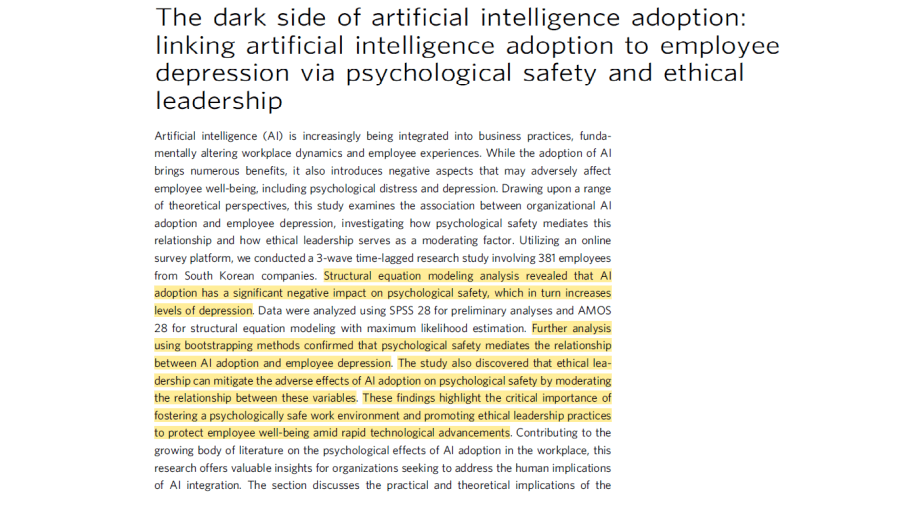
The dark side of artificial intelligence adoption: linking artificial intelligence adoption to employee depression via psychological safety and ethical leadership
Can adopting workplace AI technologies adversely affect employee psychological distress and depression? Yes according to this study. Online surveys of 381 employees in S.Korean companies was used. Background: · “In AI-centric environments .. AI reshapes jobs and workflows, affecting workers’ psychological health, satisfaction, commitment, and performance, as well as broader organizational outcomes” · “While AI adoption affects… Continue reading The dark side of artificial intelligence adoption: linking artificial intelligence adoption to employee depression via psychological safety and ethical leadership
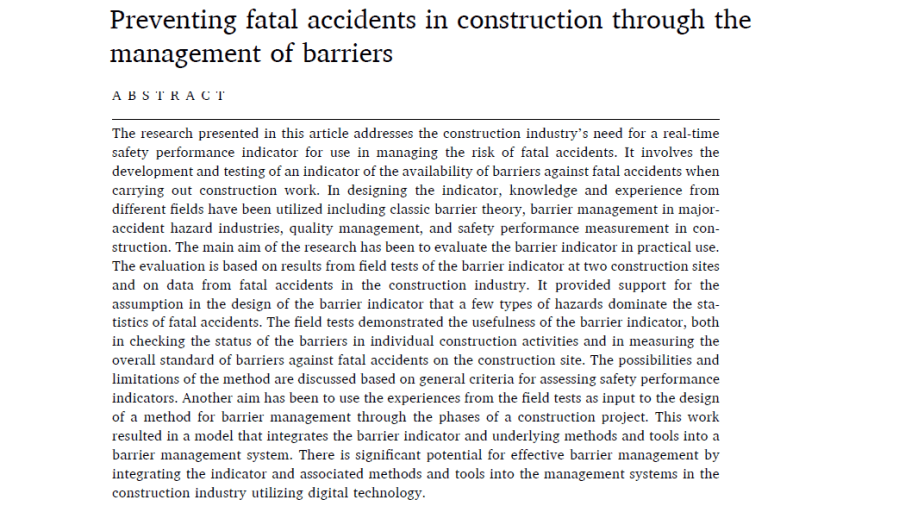
Preventing fatal accidents in construction through the management of barriers
This paper explored a (close-to) real-time safety performance indicator for barriers (sometimes called ‘controls’, although other typologies place barriers and safeguards under the broader category of ‘barriers’). The author developed and tested an indicator for the availability of barriers against fatal accidents during construction work. I’ve skipped a lot – but it’s open access, so… Continue reading Preventing fatal accidents in construction through the management of barriers
Night shifts and large gaps between work-as-prescribed and work-as-done: Maritime NZ case
Final post from the Maritime NZ case where the CEO (Gibson) was charged under a failure to exercise due diligence for a work fatality (Ports of Auckland Limited (POAL). Some extracts on night shift work and work-as-done: · “prior to Mr Kalati’s death, there was a culture, particularly on the nightshift, of the stevedores engaging in… Continue reading Night shifts and large gaps between work-as-prescribed and work-as-done: Maritime NZ case

CEO & board not receiving clear information on effectiveness of critical controls – Maritime NZ case
Fourth post from the Maritime NZ case where the CEO (Gibson) was charged under a failure to exercise due diligence for a work fatality (Ports of Auckland Limited (POAL). Some extracts on critical risks and controls: (** Post 2 in comments) · “As Mr Kahler succinctly put it, “gravity is generally [the] most common killer of… Continue reading CEO & board not receiving clear information on effectiveness of critical controls – Maritime NZ case
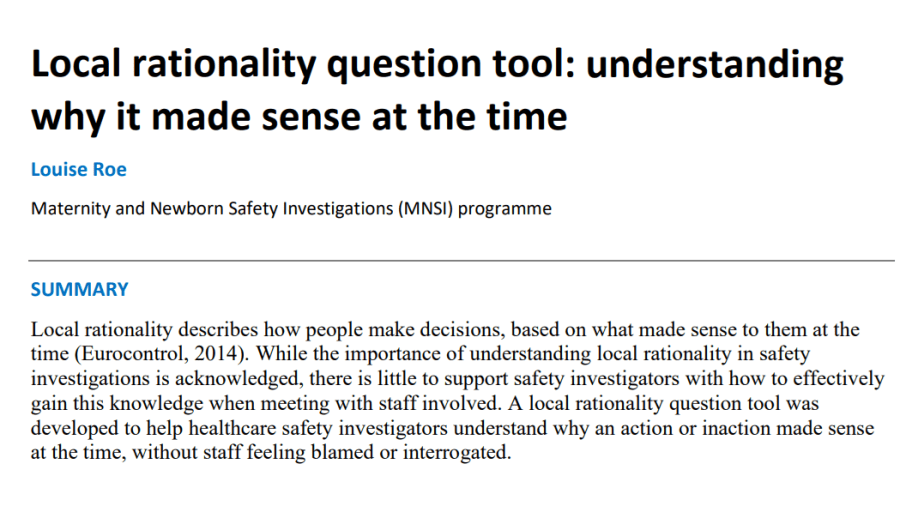
Local rationality question tool: understanding why it made sense at the time
An interesting tool for exploring a local rationality question tool (LRQ) in practice from Louise Roe, based on her conference paper. The tool has 25 items across situation, thoughts / decision making, preparedness, communication and anticipation. I’ve just covered a couple of sections (images 1 & 2). Extracts: · This tool has been used by the… Continue reading Local rationality question tool: understanding why it made sense at the time

