
Want to add a garnish of Safety-II inspired thinking into debriefs? Check out this 4 min quickisode. Today’s article is: Bentley, S. K., McNamara, S., Meguerdichian, M., Walker, K., Patterson, M., & Bajaj, K. (2021). Debrief it all: a tool for inclusion of Safety-II. Advances in Simulation, 6(1), 9. Spotify: https://open.spotify.com/episode/54H6o9h4ZiSSlgVFOjAqC6?si=kY5uaG1sRlyCW10ylAsmgw Apple: https://spotifycreators-web.app.link/e/ukQV4y4RRVb Make sure to subscribe… Continue reading Safe As ep 23 (quickisode 2): Safety-II debrief tool
Tag: healthcare

Endoscopist De-Skilling after Exposure to Artificial Intelligence in Colonoscopy: A Multicenter Observational Study
Does AI use contribute to de-skilling? Probably, according to this study of endoscopists. This study compared >1.4k patient outcomes who underwent non-AI assisted colonoscopy before and after AI implementation. Background: · A recent meta-analysis of 20 randomised trials “showed an absolute 8.1 % increase in ADR [Adenoma detection rate] with the use of AI during colonoscopy.5… Continue reading Endoscopist De-Skilling after Exposure to Artificial Intelligence in Colonoscopy: A Multicenter Observational Study

Safe As podcast ep15: Root Cause Analyses (RCA) and incident prevention – do they ‘work’?
Many organisations rely on their root cause analyses (RCA) to help learn about incidents, and, ideally, prevent incident reoccurrences. So the logic goes. But does the published evidence support RCA approaches as effective means for preventing incident reoccurrences? Today’s paper is Martin-Delgado, J., Martínez-García, A., Aranaz, J. M., Valencia-Martín, J. L., & Mira, J. J.… Continue reading Safe As podcast ep15: Root Cause Analyses (RCA) and incident prevention – do they ‘work’?
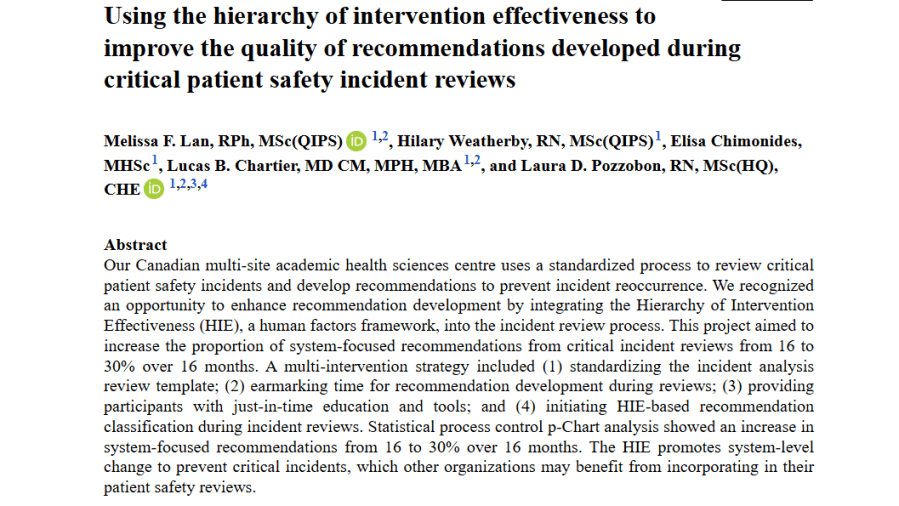
Using the hierarchy of intervention effectiveness to improve the quality of recommendations developed during critical patient safety incident reviews
This study evaluated the Hierarch of Intervention Effective (HIE) for improving patient safety incident recommendations. They were namely interested in increasing the proportion of system-focused recommendations. Data came from over 16 months. Extracts: Ref: Lan, M. F., Weatherby, H., Chimonides, E., Chartier, L. B., & Pozzobon, L. D. (2025, June). Using the hierarchy of intervention… Continue reading Using the hierarchy of intervention effectiveness to improve the quality of recommendations developed during critical patient safety incident reviews
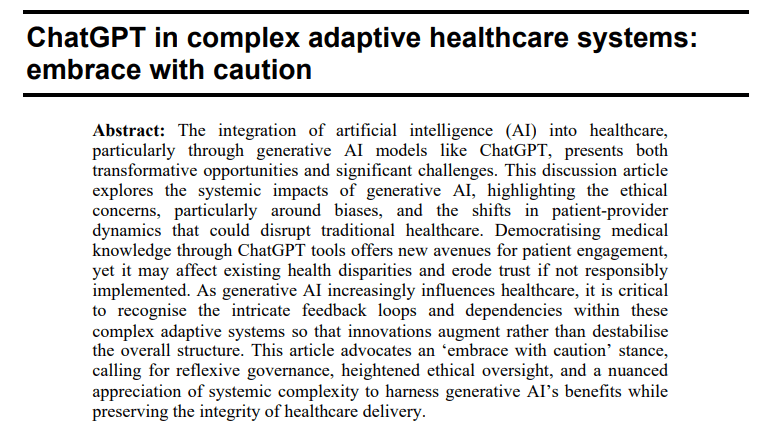
ChatGPT in complex adaptive healthcare systems: embrace with caution
This discussion paper explored the introduction of AI systems into healthcare. It covers A LOT of ground, so just a few extracts. Extracts: · “This article advocates an ‘embrace with caution’ stance, calling for reflexive governance, heightened ethical oversight, and a nuanced appreciation of systemic complexity to harness generative AI’s benefits while preserving the integrity of… Continue reading ChatGPT in complex adaptive healthcare systems: embrace with caution
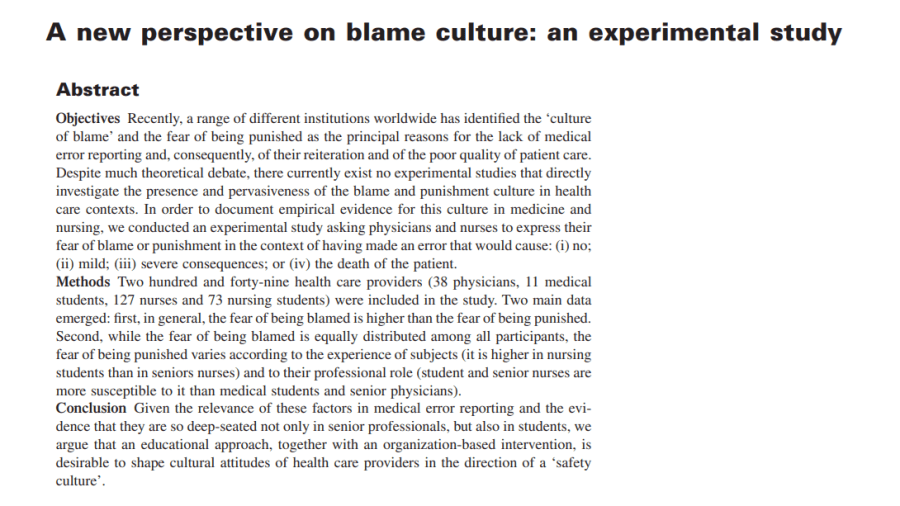
A new perspective on blame culture: an experimental study
This study explored how fear of blame and punishment affects different healthcare professions, experience levels and gender. 249 healthcare practitioners were involved, and were asked how fear of blame or punishment resulting from an error which caused no, mild, severe or death of a patient. Extracts: · “blame culture can be defined as a set of… Continue reading A new perspective on blame culture: an experimental study

Open-access healthcare debriefing videos need to incorporate more Safety-II learnings
Are Safety-II concepts used in debriefing? This explored the language and framings used in open access debriefing videos, to ascertain whether the questioning probes deeper into S-I (focus on failure/error) or S-II (focus on normal work, variability, success) questioning. Note: Only 7 videos met inclusion for transcription/evaluation. They note that learning from success isn’t “uncommon… Continue reading Open-access healthcare debriefing videos need to incorporate more Safety-II learnings

Night shift work and indicators of cardiovascular risk: a systematic review and meta-analysis
This may interest people – a meta-analysis and systematic review of the effects night shift work has on markers of cardiovascular risk. Not a summary – you can read the full open access paper. 81 studies met inclusion criteria – 14 cohort and 67 cross-sectional. Findings: · “Night shift work is associated with increased inflammation · “HDL-C… Continue reading Night shift work and indicators of cardiovascular risk: a systematic review and meta-analysis

Avoiding ‘second victims’ in healthcare: what support do staff want for coping with patient safety incidents, what do they get and is it effective? A systematic review
This systematic review evaluated evidence for what support staff want vs what they receive, and whether the support is effective. 99 studies were included. Some extracts: · PSI (patient safety incident) lead to emotional shame, guilt, anger, shock, depression, fear, flashbacks, helplessness, fatigue, withdrawal and more · The three most desired support types staff want before and… Continue reading Avoiding ‘second victims’ in healthcare: what support do staff want for coping with patient safety incidents, what do they get and is it effective? A systematic review
The science of human factors: separating fact from fiction
This brief read discussed some of the misconceptions about human factors for healthcare improvement. It’s open access, so you can read the paper yourself. They discuss where training interventions are likely to be appropriate vs not appropriate. More appropriate uses is: · To help familiarise people with new tools or functions, which should include strengths and… Continue reading The science of human factors: separating fact from fiction
 SafetyInsights.org