
A 2001 article from Sid Dekker discussing a contemporary view of human performance and organisational failure. You may recognise parts of this from Dekker’s later article ‘Is it 1947 yet?’. Too much to cover. And I’m relying heavily on quotes. Dekker reverts back to Fitts and Jones’ 1947 article which “laid the foundation for aviation… Continue reading Disinheriting Fitts and Jones `47 (2001 Sid Dekker article)
Tag: human factors
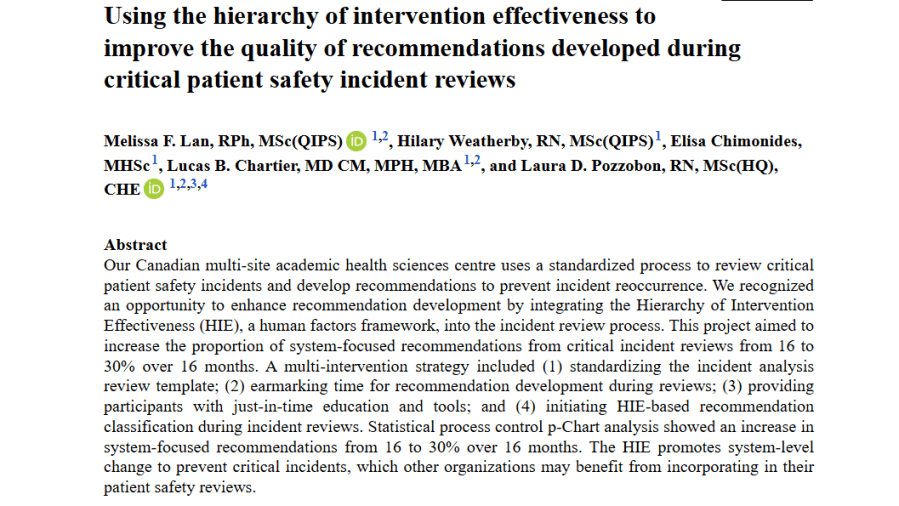
Using the hierarchy of intervention effectiveness to improve the quality of recommendations developed during critical patient safety incident reviews
This study evaluated the Hierarch of Intervention Effective (HIE) for improving patient safety incident recommendations. They were namely interested in increasing the proportion of system-focused recommendations. Data came from over 16 months. Extracts: Ref: Lan, M. F., Weatherby, H., Chimonides, E., Chartier, L. B., & Pozzobon, L. D. (2025, June). Using the hierarchy of intervention… Continue reading Using the hierarchy of intervention effectiveness to improve the quality of recommendations developed during critical patient safety incident reviews

Ergonomics & Human factors: fade of a discipline
This commentary from de Winter and Eisma argues that Human Factors & Ergonomics (HFE) may be “losing credibility” and significance. Despite claims about being a thriving science, it’s argued that the discipline may be at risk of slowly fading because of some of these challenges. This paper had several follow-up articles and rebuttals from other… Continue reading Ergonomics & Human factors: fade of a discipline
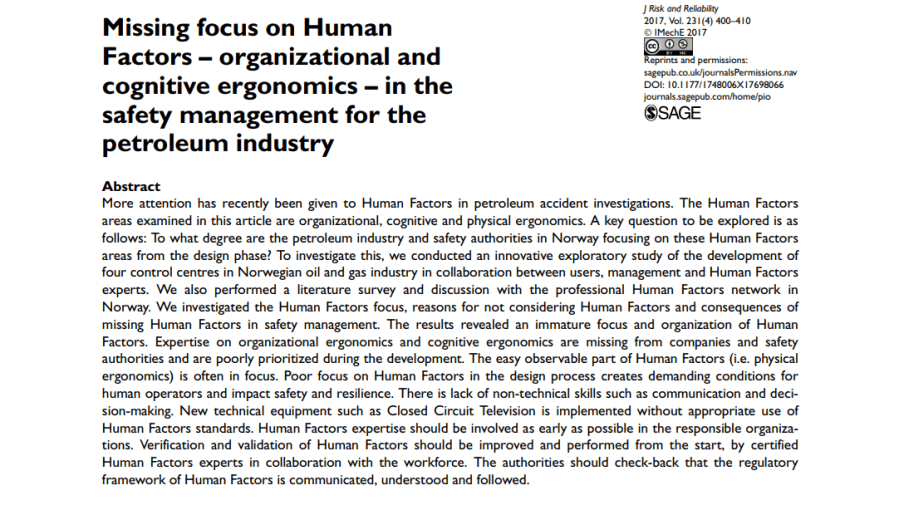
Missing focus on Human Factors – organizational and cognitive ergonomics – in the safety management for the petroleum industry
This article explored the application of HF/E in Norwegian petroleum industry (as of 2017). Some of the results were pretty interesting, and representative of elsewhere. Findings: · “results revealed an immature focus and organization of Human Factors” · “Expertise on organizational ergonomics and cognitive ergonomics are missing from companies and safety authorities and are poorly prioritized during… Continue reading Missing focus on Human Factors – organizational and cognitive ergonomics – in the safety management for the petroleum industry

Preventing serious injuries & fatalities: time for a sociotechnical model for an operational risk management system
Here’s a 2008 article from Fred Manuele which was included in my SIF compendium (link to compendium & article below). Fred explores a sociotechnical approach to preventing SIFs. The fatality rate in the US from 1971 to 2005 decreased from 17 to 4, but remained stable from 06 to 2011 at ~3.5; hence SIF prevention… Continue reading Preventing serious injuries & fatalities: time for a sociotechnical model for an operational risk management system

Residual risk and the psychology of lower order controls
This conference paper briefly discussed the follies of lower order controls in the context of human performance. Nicely, it took a really empathetic view of people and their limits in perception and attention: it’s not a bug that needs to be blamed or feared, but just a biological feature which needs to be considered. First… Continue reading Residual risk and the psychology of lower order controls
Identification of management traits related to human factors in new views of safety approaches
This paper from Leônidas Brasileiro and colleagues evaluated common attributes across approaches grouped under ‘New View’. i.e. HRO, S-II, SD, RE & HOP – they used both literature and Delphi method. Not a summary since you can read the full paper. It’s an accessible read if you’re keen to quickly understand some key differences and… Continue reading Identification of management traits related to human factors in new views of safety approaches

Human Factors and Ergonomics in Industry 5.0 —A Systematic Literature Review
This open access article may interest people – it explored the future of human factors/ergonomics in Industry 5.0 (I05). Not a summary but you can read the full paper freely. Some extracts: Shout me a coffee Study link: https://doi.org/10.3390/app15042123 LinkedIn post: https://www.linkedin.com/posts/benhutchinson2_this-open-access-article-may-interest-people-activity-7300617102564933632-WGPj?utm_source=share&utm_medium=member_desktop&rcm=ACoAAAeWwekBvsvDLB8o-zfeeLOQ66VbGXbOpJU

Human factor analysis of cockpit work incidents in high-speed workboats: the mystery hidden between the lines
This study unpacked what investigators look at and how they construct causes in high-speed workboats. It employed a Safety-II / HOP / HF perspective. Tl;dr: human factors are poorly evaluated and largely seen as individual-level factors. Some extracts: · “Although the analysis focused on negative observations, it also identified HFs that supported the activity” · “Many pivotal… Continue reading Human factor analysis of cockpit work incidents in high-speed workboats: the mystery hidden between the lines
Learning from normal work: How to Proactively Reduce Risk When Nothing Goes Wrong
An interesting article from Marcin Nazaruk, exploring learning from everyday work. Skipping a bit, so check out the full article. First he says that while it’s important to learn from failure “it is too late”. For one, diminishing incident rates “can no longer accurately reflect safety performance … and simply focusing on behaviours and unsafe… Continue reading Learning from normal work: How to Proactively Reduce Risk When Nothing Goes Wrong
 SafetyInsights.org