
Are Safety-II concepts used in debriefing? This explored the language and framings used in open access debriefing videos, to ascertain whether the questioning probes deeper into S-I (focus on failure/error) or S-II (focus on normal work, variability, success) questioning. Note: Only 7 videos met inclusion for transcription/evaluation. They note that learning from success isn’t “uncommon… Continue reading Open-access healthcare debriefing videos need to incorporate more Safety-II learnings
Tag: safety science

Control charts for accident frequency: a motivation for real-time occupational safety monitoring
This paper compares real-time or active monitoring of safety incidents via cumulative sum (CUSUM) control charts. It’s an interesting read, and if you’re not savvy with control charts or statistics then just skip over the technical stuff. Some of the findings are still pretty relevant. In saying that, I’ve skipped most of the dense statistical… Continue reading Control charts for accident frequency: a motivation for real-time occupational safety monitoring

Compendium of Nancy Leveson: STAMP, STPA, CAST and Systems Thinking
Although I don’t often mention or post about Leveson’s work, she’s probably been the most influential thinker on my approach after Barry Turner. So here is a mini-compendium covering some of Leveson’s work. Feel free to shout a coffee if you’d like to support the growth of my site: https://direct.mit.edu/books/oa-monograph/2908/Engineering-a-Safer-WorldSystems-Thinking-Applied https://doi.org/10.1177/0170840608101478 https://doi.org/10.1145/7474.7528 http://therm.ward.bay.wiki.org/assets/pages/documents-archived/safety-3.pdf http://sunnyday.mit.edu/papers/Rasmussen-Legacy.pdf https://www.tandfonline.com/doi/pdf/10.1080/00140139.2015.1015623… Continue reading Compendium of Nancy Leveson: STAMP, STPA, CAST and Systems Thinking
Failing audits and ‘comprehensively shallow’ evaluations of system performance
Do (some) audits focus too greatly on paperwork? Or is the paperwork focus a strength of audits? In our previous paper, we reviewed 44 major accident reports to assess the accident inquiries’ descriptions of pre-accident audit performance. We argued that: “many audits exhibited a ‘comprehensive shallowness,’ delving excessively into minor system details and paperwork rather… Continue reading Failing audits and ‘comprehensively shallow’ evaluations of system performance

Work injuries and mental health challenges: A meta-analysis of the bidirectional relationship
This meta-analysis investigated the relationship between work injuries and mental health challenges. 139 studies included. Background: · Mental health challenge is defined as prolonged deviations from the state of an individual’s psychological well-being · “These deviations manifest as noticeable shifts in cognition, emotion, or behavior resulting in psychological distress” · “various studies have documented that work injuries are… Continue reading Work injuries and mental health challenges: A meta-analysis of the bidirectional relationship

Co-exposures to physical and psychosocial work factors increase the occurrence of workplace injuries among French care workers
Psychosocial and physical workplace exposures found to be co-related in workplace injury (WI), according to this study. It’s one of heaps of studies highlighting the interactions between psychosocial factors and physical and psychological injury. E.g. Physical exposures were on their own were not great predictors of self-declared injury, and it was the interactions that best… Continue reading Co-exposures to physical and psychosocial work factors increase the occurrence of workplace injuries among French care workers
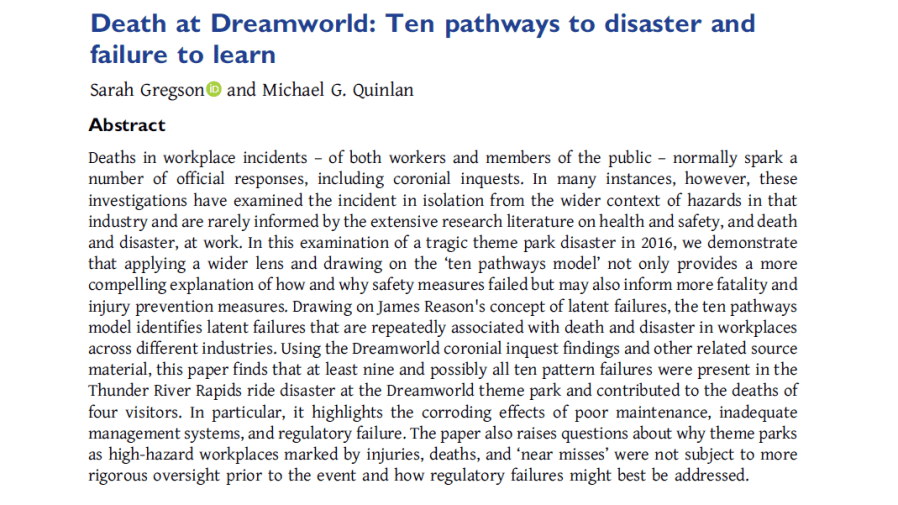
Death at Dreamworld: Ten pathways to disaster and failure to learn
This paper from Sarah Gregson and Michael Quinlan applies his ten pathways framework to the Dreamworld accident in 2016, killing four people. I’ve skipped a lot. [** Yes, hindsight and outcome biases are present with this type of analysis, as with my own auditing work. Doesn’t mean there isn’t value in exploring learning opportunities, but… Continue reading Death at Dreamworld: Ten pathways to disaster and failure to learn

Designing work systems for resilient performance: insights from resilience engineering
This explored Design for Resilient Performance (DfRP) via their framework. Not a summary – just a few extracts, but maybe I’ll summarise it in the future. Some extracts: · “Resilient performance (RP) is a socio-technical system’s ability to adjust its functioning prior to, during, or following changes and disturbances, thereby sustaining operations under both expected and… Continue reading Designing work systems for resilient performance: insights from resilience engineering

Avoiding ‘second victims’ in healthcare: what support do staff want for coping with patient safety incidents, what do they get and is it effective? A systematic review
This systematic review evaluated evidence for what support staff want vs what they receive, and whether the support is effective. 99 studies were included. Some extracts: · PSI (patient safety incident) lead to emotional shame, guilt, anger, shock, depression, fear, flashbacks, helplessness, fatigue, withdrawal and more · The three most desired support types staff want before and… Continue reading Avoiding ‘second victims’ in healthcare: what support do staff want for coping with patient safety incidents, what do they get and is it effective? A systematic review

Unveiling Untapped Potential: Leveraging Accident Narratives for Enhanced Construction Safety Management
This study explored the value and insights derived from investigation reports, comparing tabulated data vs extracted narratives. It was interested in what sorts of trends and insights about risk factors could be derived from either data stream. Their method to extract the info was tested against 400 OSHA reports. For context: · Tabular data is… Continue reading Unveiling Untapped Potential: Leveraging Accident Narratives for Enhanced Construction Safety Management
 SafetyInsights.org