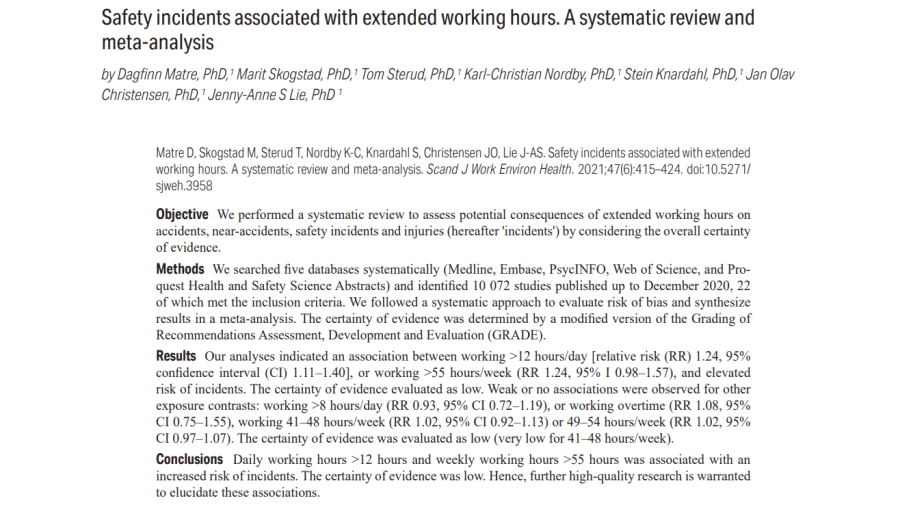
This meta-analysis evaluated whether extended working hours is associated with work injury (either during or after work). 22 studies were included. This study didn’t find significant evidence for all of the expected links found in other studies (e.g. weak or no association between working overtime on incidents), and this is likely a result of their… Continue reading Safety incidents associated with extended working hours. A systematic review and meta-analysis
Tag: health

The Psychosocial Hierarchy of Controls: Effectively Reducing Psychosocial Hazards at Work
This study redesigned the hierarchy of controls (HoC) to target workplace psychosocial hazards, specifically, adapting the NIOSH Total Worker Health HoC. These called this the Psychosocial Hierarchy of Control (P-HoC). Won’t be anything earth shattering for most, but nice to see it properly articulated. For background: · “There is consistent evidence that psychosocial hazards at… Continue reading The Psychosocial Hierarchy of Controls: Effectively Reducing Psychosocial Hazards at Work

Mental Health Causation in the Construction Industry: A Systematic Review Employing a Psychological Safety Climate Model
This systematic review studied the links between psychological safety climate (PSC) on mental health in the construction industry. 71 studies included. Key findings: · 42 mental health causation factors were identified · High job demand was the most significant contributor, followed by interpersonal relationships, low job control, low job support, and physical status · High job demand was… Continue reading Mental Health Causation in the Construction Industry: A Systematic Review Employing a Psychological Safety Climate Model

Occupational moral injury and mental health: systematic review and meta-analysis
This meta-analysis studied the links between occupational moral injury and mental health. Two key terms are morally injurious experiences (PMIEs) and post-traumatic stress disorder (PTSD). PMIEs include “‘perpetrating, failing to prevent, bearing witness to, or learning about acts that transgress deeply help moral beliefs and expectations”. PMIEs can result in “significant psychological distress or moral… Continue reading Occupational moral injury and mental health: systematic review and meta-analysis

Building Resilience into Safety Management Systems: Precursors and Controls to Reduce Serious Injuries and Fatalities (SIFs)
Another on SIF prevention. This (interim) report (another from the recent compendium – see comments for link) covers the findings from a few activities, including two SIF workshops about ID, implementing and monitoring critical controls for SIF hazards, and the role of human and org factors. Too much to cover, so a few extracts: · “the… Continue reading Building Resilience into Safety Management Systems: Precursors and Controls to Reduce Serious Injuries and Fatalities (SIFs)

Work injuries and mental health challenges: A meta-analysis of the bidirectional relationship
This meta-analysis investigated the relationship between work injuries and mental health challenges. 139 studies included. Background: · Mental health challenge is defined as prolonged deviations from the state of an individual’s psychological well-being · “These deviations manifest as noticeable shifts in cognition, emotion, or behavior resulting in psychological distress” · “various studies have documented that work injuries are… Continue reading Work injuries and mental health challenges: A meta-analysis of the bidirectional relationship

Night shift work and indicators of cardiovascular risk: a systematic review and meta-analysis
This may interest people – a meta-analysis and systematic review of the effects night shift work has on markers of cardiovascular risk. Not a summary – you can read the full open access paper. 81 studies met inclusion criteria – 14 cohort and 67 cross-sectional. Findings: · “Night shift work is associated with increased inflammation · “HDL-C… Continue reading Night shift work and indicators of cardiovascular risk: a systematic review and meta-analysis

Avoiding ‘second victims’ in healthcare: what support do staff want for coping with patient safety incidents, what do they get and is it effective? A systematic review
This systematic review evaluated evidence for what support staff want vs what they receive, and whether the support is effective. 99 studies were included. Some extracts: · PSI (patient safety incident) lead to emotional shame, guilt, anger, shock, depression, fear, flashbacks, helplessness, fatigue, withdrawal and more · The three most desired support types staff want before and… Continue reading Avoiding ‘second victims’ in healthcare: what support do staff want for coping with patient safety incidents, what do they get and is it effective? A systematic review

Coffee drinking timing and mortality in US adults (** tl;dr: coffee is awesome)
This may interest people, exploring the role of coffee drinking on all-cause mortality and Cardiovascular disease (CVD). Large sample, but observational and via 7-day dietary record, with follow-up periods. Note: Normally we need to be cautious with study methods and limits, but since we’re dealing with coffee – I’ll accept no ill spoken. Coffee defies… Continue reading Coffee drinking timing and mortality in US adults (** tl;dr: coffee is awesome)

Imbalanced sleep increases mortality risk by 14–34%: a meta-analysis
Poor sleep increases mortality risk by 14 – 34% according to a new meta-analysis. 79 cohort studies were included. Findings: · Inadequate sleep was defined as fewer than 7 h per night · 1/3 of adults regularly experience insufficient sleep which are “driven by lifestyle factors deeply rooted in modern society” · Chronic sleep deprivation has been linked… Continue reading Imbalanced sleep increases mortality risk by 14–34%: a meta-analysis
 SafetyInsights.org