
Here’s a 2008 article from Fred Manuele which was included in my SIF compendium (link to compendium & article below). Fred explores a sociotechnical approach to preventing SIFs. The fatality rate in the US from 1971 to 2005 decreased from 17 to 4, but remained stable from 06 to 2011 at ~3.5; hence SIF prevention… Continue reading Preventing serious injuries & fatalities: time for a sociotechnical model for an operational risk management system
Tag: ohs

Failing to learn and learning to fail (intelligently): How great organizations put failure to work to innovate and improve
An interesting paper from Mark Cannon & Amy Edmondson about failing intelligently. Opening the paper they argue that while the idea of organisations learning from their failures is obvious – “yet organizations that systematically learn from failure are rare”. They’ve also found that few organisations effectively experiment to learn, which requires by necessity generating failures… Continue reading Failing to learn and learning to fail (intelligently): How great organizations put failure to work to innovate and improve
“there is no such thing as a root cause [and therefore] there is technically no such thing as the beginning of a mishap” — Dekker
Extracts from Dekker’s work about the ontological and empirical shakiness of ‘root causes’. I’ve taken material from two versions of The Field Guide to Understanding Human Error (Investigations). In Dekker’s view: · “There is no ‘root’ cause” (or ‘root causes’) · Given the multiple angles and interactions in complex systems, you “can really construct “causes” from everywhere”… Continue reading “there is no such thing as a root cause [and therefore] there is technically no such thing as the beginning of a mishap” — Dekker

Workplace Psychosocial Factors and Their Association With Musculoskeletal Disorders
More data on the links between workplace psychosocial factors and injury – this time specifically on musculoskeletal disorders (MSD). 47 studies met inclusion. Findings: · The most common MSDs investigated were lower back pain, neck and shoulder pain, and upper extremity symptoms and disorders · Workplace psychosocial factors that were statistically significant were support, collaboration, job control,… Continue reading Workplace Psychosocial Factors and Their Association With Musculoskeletal Disorders

Work injuries and mental health challenges: A meta-analysis of the bidirectional relationship
This meta-analysis investigated the relationship between work injuries and mental health challenges. 139 studies included. Background: · Mental health challenge is defined as prolonged deviations from the state of an individual’s psychological well-being · “These deviations manifest as noticeable shifts in cognition, emotion, or behavior resulting in psychological distress” · “various studies have documented that work injuries are… Continue reading Work injuries and mental health challenges: A meta-analysis of the bidirectional relationship

Co-exposures to physical and psychosocial work factors increase the occurrence of workplace injuries among French care workers
Psychosocial and physical workplace exposures found to be co-related in workplace injury (WI), according to this study. It’s one of heaps of studies highlighting the interactions between psychosocial factors and physical and psychological injury. E.g. Physical exposures were on their own were not great predictors of self-declared injury, and it was the interactions that best… Continue reading Co-exposures to physical and psychosocial work factors increase the occurrence of workplace injuries among French care workers

Compendium: Sleep & Fatigue Risk Management
Here’s an assortment of papers on sleep and occupational fatigue. Focus is on articles I’ve summarised or full-text I could locate. A few themes are covered: Feel free to shout a coffee if you’d like to support the growth of my site: Sleep & Fatigue https://www.academia.edu/30709111/Fatigue_proofing_A_new_approach_to_reducing_fatigue_related_risk_using_the_principles_of_error_management https://jcsm.aasm.org/doi/pdf/10.5664/jcsm.9512 https://www.academia.edu/7558212/A_Model_to_Predict_Work_Related_Fatigue_Based_on_Hours_of_Work https://doi.org/10.1016/j.aap.2021.106398 https://www.academia.edu/115005821/Effects_of_fatigue_on_surgeon_performance_and_surgical_outcomes_a_systematic_review https://www.researchgate.net/publication/6495463_The_dynamics_of_neurobehavioural_recovery_following_sleep_loss https://academic.oup.com/sleep/article-abstract/20/4/267/2732104?redirectedFrom=PDF https://www.researchgate.net/publication/49656992_Research_needs_and_opportunities_for_reducing_the_adverse_safety_consequences_of_fatigue https://www.degruyter.com/document/doi/10.1515/eng-2022-0411/pdf https://www.jstage.jst.go.jp/article/indhealth/47/5/47_5_518/_pdf… Continue reading Compendium: Sleep & Fatigue Risk Management
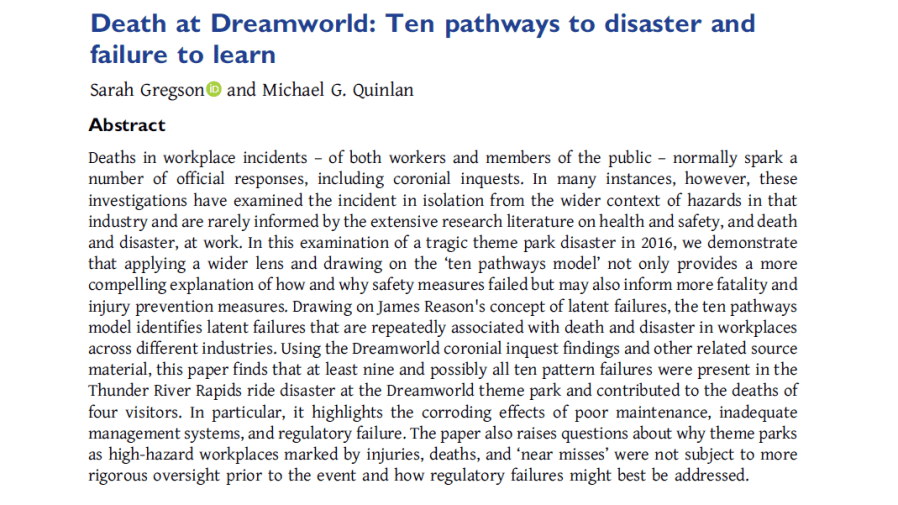
Death at Dreamworld: Ten pathways to disaster and failure to learn
This paper from Sarah Gregson and Michael Quinlan applies his ten pathways framework to the Dreamworld accident in 2016, killing four people. I’ve skipped a lot. [** Yes, hindsight and outcome biases are present with this type of analysis, as with my own auditing work. Doesn’t mean there isn’t value in exploring learning opportunities, but… Continue reading Death at Dreamworld: Ten pathways to disaster and failure to learn

Avoiding ‘second victims’ in healthcare: what support do staff want for coping with patient safety incidents, what do they get and is it effective? A systematic review
This systematic review evaluated evidence for what support staff want vs what they receive, and whether the support is effective. 99 studies were included. Some extracts: · PSI (patient safety incident) lead to emotional shame, guilt, anger, shock, depression, fear, flashbacks, helplessness, fatigue, withdrawal and more · The three most desired support types staff want before and… Continue reading Avoiding ‘second victims’ in healthcare: what support do staff want for coping with patient safety incidents, what do they get and is it effective? A systematic review

Unveiling Untapped Potential: Leveraging Accident Narratives for Enhanced Construction Safety Management
This study explored the value and insights derived from investigation reports, comparing tabulated data vs extracted narratives. It was interested in what sorts of trends and insights about risk factors could be derived from either data stream. Their method to extract the info was tested against 400 OSHA reports. For context: · Tabular data is… Continue reading Unveiling Untapped Potential: Leveraging Accident Narratives for Enhanced Construction Safety Management
 SafetyInsights.org