
Psychosocial and physical workplace exposures found to be co-related in workplace injury (WI), according to this study. It’s one of heaps of studies highlighting the interactions between psychosocial factors and physical and psychological injury. E.g. Physical exposures were on their own were not great predictors of self-declared injury, and it was the interactions that best… Continue reading Co-exposures to physical and psychosocial work factors increase the occurrence of workplace injuries among French care workers

Root-Causal Factors: Uncovering the Hows & Whys of Incidents
This 2016 article from Fred Manuele explores some facets of causality in investigations. It’s based mainly on two key sources: Hollnagel’s 2004 ‘Barriers and accident prevention’ and Dekker’s 2006 ‘Field Guide to Understanding Human Error’. Won’t be much new for most but has some nice arguments from authors like Hollnagel, Dekker and Leveson. First he… Continue reading Root-Causal Factors: Uncovering the Hows & Whys of Incidents

Compendium: Sleep & Fatigue Risk Management
Here’s an assortment of papers on sleep and occupational fatigue. Focus is on articles I’ve summarised or full-text I could locate. A few themes are covered: Feel free to shout a coffee if you’d like to support the growth of my site: Check out my YouTube channel: https://youtube.com/@safe_as_pod?si=sZmhFw3gB3ubXjzK Sleep & Fatigue https://www.academia.edu/30709111/Fatigue_proofing_A_new_approach_to_reducing_fatigue_related_risk_using_the_principles_of_error_management https://jcsm.aasm.org/doi/pdf/10.5664/jcsm.9512 https://www.academia.edu/7558212/A_Model_to_Predict_Work_Related_Fatigue_Based_on_Hours_of_Work https://doi.org/10.1016/j.aap.2021.106398… Continue reading Compendium: Sleep & Fatigue Risk Management
What topics do you want to see next for research compendiums?
What topics do you want to see for research compendiums? Let me know here. Next up are:1) fatigue & sleep2) Nancy Leveson’s work3) SIFs/HiPos/fatal accidents4) Systems thinking5) an ode to Deming (but struggling to find full-text articles…) What next ? If psychosocial, then what specific elements? (It’s such a vast domain…) Post a comment here:… Continue reading What topics do you want to see next for research compendiums?
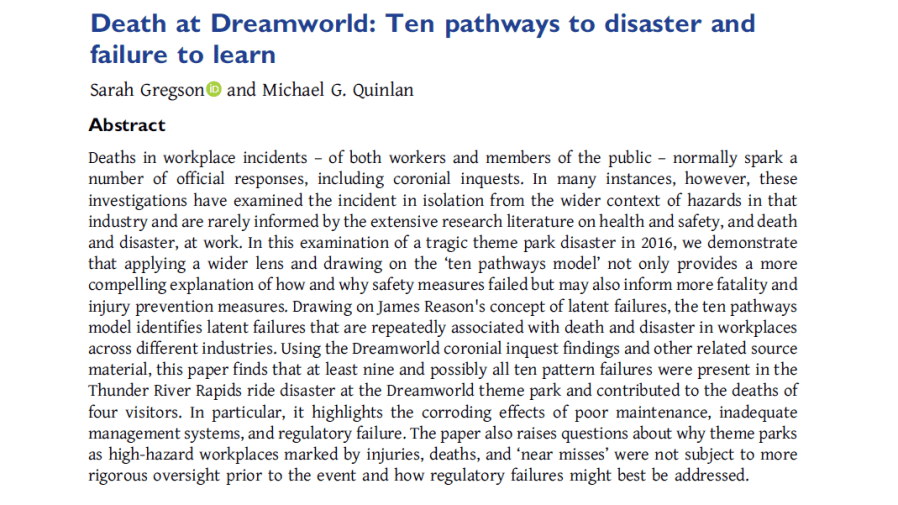
Death at Dreamworld: Ten pathways to disaster and failure to learn
This paper from Sarah Gregson and Michael Quinlan applies his ten pathways framework to the Dreamworld accident in 2016, killing four people. I’ve skipped a lot. [** Yes, hindsight and outcome biases are present with this type of analysis, as with my own auditing work. Doesn’t mean there isn’t value in exploring learning opportunities, but… Continue reading Death at Dreamworld: Ten pathways to disaster and failure to learn

Designing work systems for resilient performance: insights from resilience engineering
This explored Design for Resilient Performance (DfRP) via their framework. Not a summary – just a few extracts, but maybe I’ll summarise it in the future. Some extracts: · “Resilient performance (RP) is a socio-technical system’s ability to adjust its functioning prior to, during, or following changes and disturbances, thereby sustaining operations under both expected and… Continue reading Designing work systems for resilient performance: insights from resilience engineering

Avoiding ‘second victims’ in healthcare: what support do staff want for coping with patient safety incidents, what do they get and is it effective? A systematic review
This systematic review evaluated evidence for what support staff want vs what they receive, and whether the support is effective. 99 studies were included. Some extracts: · PSI (patient safety incident) lead to emotional shame, guilt, anger, shock, depression, fear, flashbacks, helplessness, fatigue, withdrawal and more · The three most desired support types staff want before and… Continue reading Avoiding ‘second victims’ in healthcare: what support do staff want for coping with patient safety incidents, what do they get and is it effective? A systematic review
Resilience terminology and a visualisation of resilience/robustness in practice
This may interest people. It covers concepts of resilient performance within seaports. It’s a bit random (seaports), but otherwise gives a handy overview of resilience terms and applications. The first two images are just basic definitions. Extracts: · Image 3 represents resilience elements during disruptions – from pre-disruption, to the disruption, then post-disruption. · During pre-disruption, the… Continue reading Resilience terminology and a visualisation of resilience/robustness in practice

The bad apple theory won’t work: response to ‘Challenging the systems approach: why adverse event rates are not improving’ by Dr Levitt
Another rebuttal article as a follow-up from the prior post on systems thinking in medicine, again from Dekker & Leveson. I’ve skipped Levitt’s letters which prompted these letters to the editor. Extracts: · “One can understand the seduction of sanctioning non-compliant doctors2 or getting rid of the deficient practitioners—the system’s bad apple” · They refer to research… Continue reading The bad apple theory won’t work: response to ‘Challenging the systems approach: why adverse event rates are not improving’ by Dr Levitt
Cultural elements of major accidents according to Andrew Hopkins
Not much to say, just an extract from Andrew Hopkins’ 2006 paper ‘Studying organisational cultures and their effects on safety’. I’ll be posting the summary in the coming weeks. Here he describes his analysis of the 1999 Glenbrook rail crash: · He identified four main cultural themes preceding the disaster · First “the railways were obsessively rule… Continue reading Cultural elements of major accidents according to Andrew Hopkins

