
Some extracts from Guldenmund’s interesting article ‘Organisational safety culture principles’: · Culture can be studied via different aggregated levels, with many authors relating it as “consisting of a core surrounded by one or more layers, not unlike the anatomy of an onion” · “Whereas the core is something (deeply) hidden, the culture projects itself gradually through and… Continue reading ‘Organisational safety culture principles’: In Patient safety culture

Management of safety rules and procedures
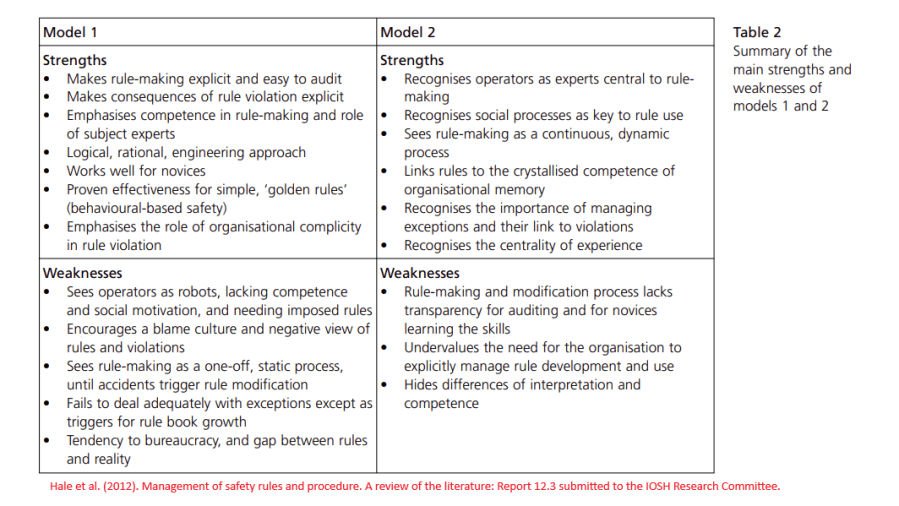
Really interesting report from Hale, Borys & Else about the nuances of rules, and contrasting model 1 / model 2. [* Check out this week’s compendium dedicated to Hale & Hopkins, link below] A few extracts: · A classic Dutch railways study showed that 3% of workers used rules often and 50% almost never, 47% found… Continue reading Management of safety rules and procedures

Exploring the relationship between major hazard, fatal and non-fatal accidents through outcomes and causes
This study from Linda Bellamy explored whether there is a relationship between major hazards, and fatal and non-fatal accidents. Analysis of 23k Dutch serious reportable accidents was analysed via the StoryBuilder software (largely based around bowties). [NB. As always, there’s certain limitations and nuances with relying on reported accidents, particularly around how they’re reported, how… Continue reading Exploring the relationship between major hazard, fatal and non-fatal accidents through outcomes and causes
Compendium: An ode to Andrew Hopkins & Andrew Hale
Two researchers & authors who have had a big impact on my practice and thinking are Andrew Hale and Andrew Hopkins. Thankfully, I was exposed to their work right at the start of my safety career. Why two Andrews? Why not three? I don’t know. Just two people who influenced my thinking around the same… Continue reading Compendium: An ode to Andrew Hopkins & Andrew Hale

Why safety performance indicators?
A response from Andrew Hale to Andrew Hopkins’ 2009 article about indicators (link in comments). [See tomorrow’s compendium dedicated to Hopkins & Hale] Extracts: · Hale starts with outlining why we need indicators, suggesting three obvious roles · Monitoring the level of safety in a system, which “answers the question: is the level of safety OK as… Continue reading Why safety performance indicators?

From the Boardroom to the Jobsite: Female Board Representation and Workplace Safety
This study explored the effects that female board representation (FBR) on workplace safety. Note: ‘safety’ in this study is based on reported incidents. So consider that caveat. Data included 266 firms and 1,442 firm-year observations. Background: · “having female directors on corporate boards can influence a firm’s financial performance (Post and Byron 2015), social responsibility… Continue reading From the Boardroom to the Jobsite: Female Board Representation and Workplace Safety
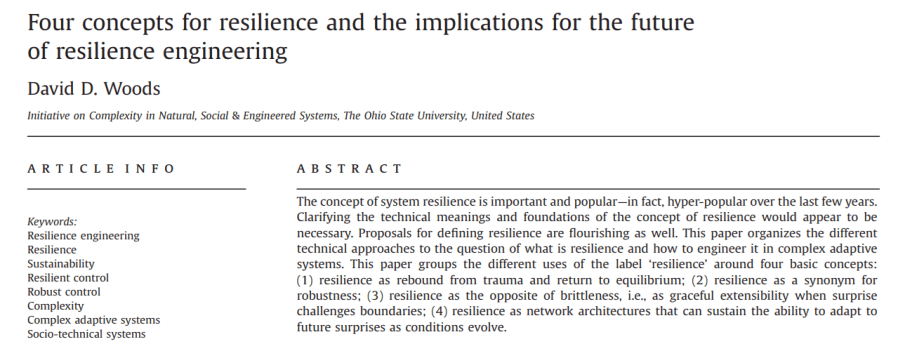
Four concepts for resilience and the implications for the future of resilience engineering
An interesting read from David Woods discussing four resilience concepts. Extracts:· While networks of interdependencies have created new value for stakeholders, it has “also created unanticipated side effects and sudden dramatic failures” · The first concept used to describe resilience is rebounding · Rebounding “begins with the question: why do some communities, groups, or individuals recover from traumatic… Continue reading Four concepts for resilience and the implications for the future of resilience engineering

Good and bad reasons: The Swiss cheese model and its critics
Really interesting historical and critical account of Reason’s work, particularly the Swiss Cheese metaphor (SCM). It was meant to be a mini-post with a few extracts, but, meh, couldn’t be bothered cutting it back. Still not a summary, and skipped HEAPS, so highly recommend reading the free open access article. Background: · Reason’s foray into… Continue reading Good and bad reasons: The Swiss cheese model and its critics

What System Safety Engineering Can Learn from the Columbia Accident (Nancy Leveson)
Leveson & Cutcher-Gershenfeld discuss systems safety in the context of the Columbia Accident Investigation Board (CAIB) investigation. NB. These types of analyses are, of course, replete with hindsight and outcome logics, and sometimes judgmental attributions (failure, inadequate). But that doesn’t inherently mean we can’t learn anything. Extracts: · “The CAIB report describes system safety engineering at… Continue reading What System Safety Engineering Can Learn from the Columbia Accident (Nancy Leveson)

The safety measurement problem revisited
A response from Kjellén to Hopkins’ 2009 article about indicators (link in comments). [See week’s compendium dedicated to Hopkins & Hale] Extracts: · “LTI-rate gives the same weight to injuries with dramatically different consequences; that the measure is easily manipulated; and that natural statistical fluctuations make it useless for feedback control of other than the largest… Continue reading The safety measurement problem revisited

